education

Why learn about learning?

paulo freire

Paulo Freire

The learning process is human, organic, and complex, in that each individual, unique in his experiences, identity, as well as socio-historical context, transforms the act of learning into an absolutely personal and self-transformational experience. However, for that process to be a truly transformational one, both of the learner and of the world surrounding him, it is necessary that the learner engages the object of study, as well as the act of studying itself, in a critical manner. For Paulo Freire, it is this critical stance facing one’s object of study, and throughout the act of studying, which propitiates the fundamental goal of education, that of creating, re-creating, and co-creating knowledge, ultimately re-creating and reinventing the world around us. This is the critical stance in face of the search for knowledge which realizes the full potential of education, which is to bring about change.

If we are to understand the act of studying, of searching for knowledge, as a process of (re)creation, then we need to admit that the process is dynamic in its nature. Critically engaging a given text is establishing a dialog with its author. It is by means of this dialog, of this questioning, and this critical vision that knowledge can be reinvented, rewritten, and recreated. For it to be so, it is necessary that the learner has a heightened sense of agency, that is, that the learner sees himself as being the agent of his education; that he acts as subject in his search for knowledge, in his learning journey. The attitude of letting oneself be domesticated or indoctrinated does not lend itself to the critical posture advocated by Freire. The subject must penetrate the text, imbued with a sense of curiosity, fearless of letting himself become problematized by his dialog with the text.

The act of letting oneself become problematized is an act of surrender to the dynamic and organic process which is learning. Being open to learning is embracing uncertainty, for the act of learning critically presupposes an engagement with the text with an open and inquisitive mind. It means to venture into the unknown. The journey of learning becomes even more revealing if we let ourselves be humbled in face of the search. Being humble is being critical, in that learning is a challenge that requires hard and systematic work, and that many times may demand more than what we are capable of responding in a given moment. We must, therefore, persist and look to become better equipped to return to the text/object of study ready to understand it, to establish a fruitful dialog with it.

It is the duty of every educator to search for self-knowledge and self-reflection as a learner. Living the experience of learning first-hand opens up a channel for important insights into the learning process which may result in disruptions necessary for the refinement of our teaching approaches, methods, and techniques, for our being/becoming educators with the full potential to foster the kind of learning experiences which will instill our learners` curiosity and critical engagement with their own education, as well as the world around them.

In the words of Paulo Freire:

“Studying is not an act of taking in ideas, but of creating and recreating them.”

FREIRE, Paulo in Considerations regarding the Act of Studying (1968)

Por que aprender sobre o aprender?

paulo freire

Paulo Freire

O processo do aprender é um processo humano, orgânico e complexo, no sentido de que cada indivíduo, com sua unicidade de experiências, identidade e contexto histórico-social, transformará o ato de aprender numa experiência absolutamente pessoal e auto-transformadora. No entanto, para que esse processo seja de fato transformador, tanto do aprendiz quanto do mundo que o cerca, é necessário que o aprendiz engaje o objeto de estudo, assim como o ato de estudar, de maneira crítica. Para Paulo Freire, é essa postura crítica diante do objeto de estudo e durante o ato de estudar que propicia o objetivo fundamental da educação: a de criar, recriar e co-criar o conhecimento, recriando, assim, o mundo que nos cerca. É essa postura crítica diante da busca do conhecimento que potencializa a educação, resultando em mudança.

Se entendermos o ato de estudar, de buscar conhecimento, como um processo de (re)criação, precisamos admitir que se trata de um processo dinâmico em sua natureza. Engajar-se de maneira crítica com determinado texto é estabelecer um diálogo com seu autor. É através do diálogo, do questionamento e do olhar crítico que o conhecimento poderá ser reinventado, rescrito e recriado. Para tanto, é necessário que o aprendiz tenha um aguçado sentido de agência, ou seja, que ele se veja agente de sua educação; que ele seja o sujeito na busca do conhecer e do aprender. O deixar-se “domesticar” ou “doutrinar” não faz parte da atitude crítica proposta por Freire. O sujeito deve penetrar o texto, imbuído de um senso de curiosidade, e sem medo de se deixar problematizar pelo diálogo com o texto.

O ato de deixar-se problematizar é um ato de entrega ao processo dinâmico e orgânico que é o aprender. Estar aberto para o aprender é abraçar a incerteza, já que o ato de aprender de maneira crítica pressupõe engajar-se com um texto com mente aberta e indagadora, de arriscar-se pelo desconhecido. A jornada do aprender se faz ainda mais reveladora se nos colocamos com humildade diante da busca. O ser humilde é ser crítico, no sentido de que o aprender é um desafio que demanda trabalho árduo e sistemático e que, muitas vezes, poderá exigir mais do que nossa capacidade de resposta em determinado momento. Devemos, assim, insistir e buscar nos equipar melhor para retornar ao texto/objeto de estudo em condições de entendê-lo e de estabelecer um diálogo produtivo com ele.

Como aprendiz, é tarefa de todo educador buscar o auto-conhecimento e a auto-reflexão. A vivência do aprender em primeira mão nos proporciona a possibilidade de insights importantes com relação ao processo de aprendizagem. Esses insigths podem resultar em rupturas necessárias para o refinamento de nossas abordagens, métodos e técnicas de ensinar, de exercer nosso papel de educadores em sua plenitude, buscando fomentar experiências de aprendizagem que instiguem a curiosidade e o engajamento crítico de nossos aprendizes com sua própria educação e com o mundo que os cerca.

Nas palavras de Paulo Freire:

“Estudar não é um ato de consumir idéias, mas de criá-las e recriá-las.”

FREIRE, Paulo in Considerações em torno do Ato de Estudar (1968)


On Wearing Two Hats: Teaching & Responding to Writing

On Wearing Two Hats-Teaching &

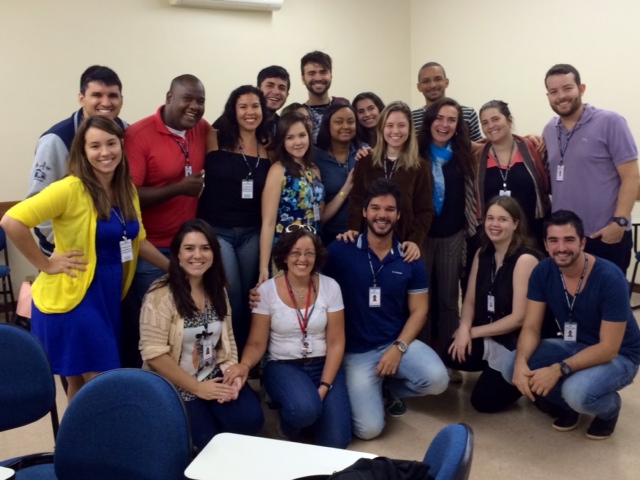
This morning I had the opportunity of engaging with quite an interesting and energetic group of bright individuals as part of our institute’s training of newly-hired teachers. The goal was to discuss the teaching of writing to our EFL learners, what it is that an effective pre-writing lesson should entail, as well as ways of responding to students’ writings. It was a hands-on session, with some initial discussion and brainstorming of lesson stages with a specific writing prompt in mind, which was then followed by their response to and correction of an authentic writing sample. The idea was to familiarize teachers with the kind of response to writing that we believe to be in keeping with the principle that writing is a recurrent process, non-linear in its creative nature, and the very expression of one’s voice.

Roll up your sleeves and let’s get down to business

Teachers worked in smaller groups and were asked to respond to and provide corrective feedback to a first draft sample of a five-paragraph essay written by an upper-intermediate level learner. Along with the sample, they received a copy of our correction and proofreading symbols, as well as a scoring rubric by means of which they’d grade that first draft. They immediately set out to accomplish the task, industriously reading the piece, red pens in hand, and… Stop. Wait a minute. Do you feel an urge to begin crossing out and underlining spelling mistakes and wrong verb tense use? You do, don’t you?

Step away from the red pen

Before you unleash your full corrective-feedback-giving potential, put on a different hat. Be a reader. Respond to your students’ content and ideas as a real person. Familiarize them with that sense of having an audience. We use language to communicate, be it in spoken or written form. Let them know that you are truly listening to them. Try to find at least a couple of aspects in their writing that are worth a compliment. Relate to their ideas, share a little about your own experience by commenting that maybe you once felt the same way as they did facing a certain situation in your own life, and that you know how wonderful or how difficult it must have been for them to go through it, as well. Empathize. Connect. Engage. 

Respect individual stylistic choices

It’s always a challenge to provide corrective feedback without stifling the writer’s voice. What I mean is, are you (over)correcting to the point of forcing the student to write as you would have if expressing a similar idea in written form? Of course there are instances of L1 interference that must be addressed, such as word order issues to name one, but we teachers walk a fine line between pointing our students in the right direction and simply imposing our own style on them. Keep an awareness of the fact that your students are experimenting with language (a foreign one, as a matter of fact), and that they are, knowingly or not, in their own quests to finding their voice. Cherish. Allow. Enable. 

Sounding curious as opposed to judgemental

Instead of saying something like “this paragraph is too short. Please develop your ideas here.” how about offering something more in the lines of “I wonder if you could tell me more about this experience/situation.” or even “how did you feel?” and “what did you do next?” The point is that by asking a simple question, you may elicit just the response you want from a student, instead of making a direct comment that might come across as judgemental, in that it is an affirmation made by you, the teacher, who is supposedly the knowledge authority on all subjects language-wise. Don’t point fingers. Ask more questions. Provoke. Entice. Foster.

This set of guidelines sprang up from this group’s engagement and reflections during our training session, so that gives you a pretty good idea of how lucky we are to have gathered such a great collection of curious and avid learner-teachers. Thank you all, Casa newbies, for inspiring me to write this piece.

photo

Welcome aboard, guys!