#rhizo14

On finding my voice (part 2) #rhizo14 autoethnography

I was sitting in a doctor’s waiting room when I read Bali Maha’s reflections on oppression. Little did I know that reading it would enable me to connect the final dots in the big picture of my life, where I came from, who I’d come to be, what choices I’d made which had boiled down to the life I had, the relationships I nurtured, my dreams and desires.

The culture within which I was born is known for its machismo, and even though women in my country have been increasingly more active in society in general, occupying positions of power which in the past would exclusively be the realm of men, it was the cultural background against which women from my generation were raised and imbued with society’s expectations towards the possible social roles we were supposed to perform. I have, however, been lucky to have been born in a family who treasures the autonomy and freedom that can only be attained by getting an education. Being the oldest daughter of an economist dad and a pedagogue mom, it has always been a family value to pursue higher education, especially in a country where good opportunities only seem to come along to the rich elite and a portion of the struggling educated middle class, the latter being our case.

My parents made a point of buying me the best education they could. I went to the best private schools in my city and was even sent in an exchange program to the U.S. in my last year of secondary school, at the age of 16. I’d been an English learner for ten years at the time, and the year I spent with an American family in Aurora, Colorado enabled me to develop a well-above-average fluency in the language. Back in Brazil, my dad pushed me forward in my education, as I was obviously expected to pass my college entrance exam and stay in touch with the English language, which kept me quite busy for a year or so, until I finally began my years as an Anthropology undergrad at the University of Brasília. My dad had, nonetheless, been less than pleased by my academic career choice. Anthropology did not (and does not) rank among the highest paying careers, no matter how intellectually fascinating or personally fulfilling it may be.

That was when teaching chose me. I’d taken a teacher training course at a small English institute in Brasília, and by the end of the six-month training, I received word from my tutor that I was what they called “a natural-born teacher”, offering me a job as a substitute teacher. I was about to turn 21 years old and was more than happy to begin earning my own money, doing something that I really enjoyed: being with people, communicating and connecting, every day.  18 years later, I look back at my path and I feel I’ve been lucky in so many ways. I survived a broken home, with my parents’ divorce at the age of nine. Not that it didn’t take its toll on my future relationships, but I have become a stronger individual as a result of this and so many other hardships I’ve come up against in my life.

There I was, reading Maha’s instigating thoughts and questions on the subject of oppression. Something inside of me began boiling. It began to dawn on me that I, too, had been in so many ways oppressed. Oppressed by expectations, by the threat of failure in not being able to find a worthwhile career that would keep me from sharing the fate of the vast majority of the population of my country, with no opportunity, no future, no dignity. I had been very well educated alright. It had all been funneled down to me, and it had somehow sunk in and taken the shape of an education that worked at its ultimate purpose: getting me into a federal university, a luxury (still to this day) to a select few, to an intellectual elite, to the middle-class kids who were (and still are) pushed to make a career choice many a times too soon, one that they’d very likely not practice in their professional future, one that they’d probably just drop midway through college (those who were brave enough to stand up to the status quo, that is).

What emerged from within my deepest inner space was a realization that I had spent most of my life oppressed by other people’s curricula and agendas. I’d been oppressed to conform and fit in the mold that was made for kids with my cultural background and my social class. I had turned into a teacher in my own right, but how much of my teaching persona had also become a replication of what I had experienced as a learner during my school years? I had been questioning beliefs that I thought were so solid, principles so sound. I had been experimenting with my intellectual abilities via my own devices, and it had all been happening in connection with others. I had been allowed to revisit and revive that exhilarating feeling I had experienced when I first began teaching, a feeling that it was all worth it and that so much meaningful learning happens in becoming part of a network, a community, in connecting with others (and with otherness) regardless of your social class, your cultural background, your formal education.

Never before had I seen so great a part of the big picture of my life, of what it was, has been, and of what I truly want it to be from now on. I really might have been working my way around oppression, tolerating it, accepting it as the only viable pathway. It is as if I have been through the kind of consciousness shift that only a powerful education, aiming at freeing the individual and allowing him to (re)create his own reality, ultimately impacting the society in which he is inserted, making it fairer, more humane, is ever capable of fostering. I might have gained greater critical consciousness, in that I have found new perspectives, explored new perspectives, and all in my own terms, working with my own cosmology/context/history.

I have experienced an existential breakthrough. I have been deeply changed by the connections and exchanges that took place during rhizo14, and not only with others, but also via others and back to my own self, allowing otherness to reverberate within my ‘uniquely furnished room’ and checking to see what possible chords would spring up. I owe it to this network/community/connections/people. I deconstructed my oppressions, and never before have I been able to see inside myself with such clarity. Not that it has given me any promises of certainty – much to the contrary. I had never cherished the unknown. I had always been afraid of not knowing the answers when the time came for me to show that I did. Never before had it been so pleasurable to learn, and to stretch my intellectual (and even artistic?) legs.

I have finally owned my education. I have made it mine via the connections with other individuals who care about owning their education as much as myself, or even more. I have learned the meaning of agency. I have had an insight into what Paulo Freire advocates in Education and Change. That education is not a mere adaptation of the individual to society. That we must transform our reality to transcend. That domestication is the opposite of education, and that education is more authentic to the extent it entices our curiosity to learn, to create and recreate reality. The learners must be themselves.

My pedagogue mom’s words on what she believes to be the core of Paulo Freire’s pedagogy:

“O homem deve ser o sujeito de sua própria educação. Não pode ser objeto dela. Por isso, ninguém educa ninguém. O homem se educa em comunhão.”

“The individual must be the agent of his own education. He cannot be its object. That is why no one educates anyone. The individual learns/self-educates in communion.”


#rhizo14 collaborative autoethnography

Rhizo14

I had started the year intent on pursuing personal and professional development. I joined #rhizo14 after some lurking adventures, and once I’d read some thought-provoking stuff in the blogosphere, I was totally compelled to ‘take whatever those people were taking’, for it really sounded like some hard-core deep learning/intellectual/creative experiences were unfolding…

I joined the course half-way through (week 4) and from there on I made an effort to participate as much as possible within my 40-hour-week job as EFL teacher/course supervisor and personal life (I have a 3-year-old). I was added to the FB group as soon as I made up my mind to join the course (on P2PU), and I was warmly welcomed right away. I became more active on Twitter – #rhizo14 towards the end of the course (on week 5-6, I’d say). I read a lot more blog posts and social media exchanges than I was able to comment on, but I did make a point of commenting on those which spoke to me more intimately. I was happy to see some rhizoers were exploring their artistic veins, and that’s something that emerged quite strongly in me during the course.

I felt pretty much a part of the rhizo14 community. It was quite clear to me from the start that I was shoulder to shoulder with people who were mostly active in the field of Education and who had all types of academic and professional backgrounds, not to mention the diverse cultural backgrounds, which made the experience all the more enticing and rich worthwhile for me. I didn’t feel excluded. I did feel that I was naturally drawn closer to specific individuals and ideas, and I took on the role of learner. I didn’t care that I was around people who were clearly accomplished, with PhDs and stuff; all I cared for was that I felt absolutely privileged to be getting to connect with such brilliant people.

My #rhizo14 experience was visceral, in that it enabled me to explore deep levels of creativity and intellectual skills which might have been unknown to me, or at least in the depth and density I experienced in #rhizo14. That is absolutely precious to me. That is my perception of success. I am changed by the #rhizo14 learning experience. I made connections that I look to nurture from here on end. I’m lucky to have you in my audience and to be in your audience, as well. It has all been worth it. Thank you, rhizoers.

pessoa

“Tudo vale a pena quando a alma não é pequena.”  Fernando Pessoa

(“All is worthwhile when the soul is not small.”)

Planned, yet unrehearsed obsolescence #rhizo14

rhizo47

rhizo47

sensory experience: wanna try? Listen to this while reading

I see rhizomes everywhere

Last friday I conducted a routine test validation session with a group of twenty teachers. Although the ultimate purpose of meetings such as this one is to calibrate and make adjustments to a specific assessment instrument, it is also a precious opportunity to tap into the collective knowledge and experiences that those teachers are having in their piloting experiences using recently adopted course books. This was the second time I tried out  a specific set of group dynamics in which  small clusters of 4 to 5 people engage with the instrument being assessed and with each other. Once those nodes were all set, we were off. As we progressed in the assessment of the instrument, relevant connections began to sprang up in conversation about pertinent classroom situations, activities, approaches to a given subject/skill, and as we seized these opportunitites to ask questions, discuss issues, share difficulties, our co-constructed space seemed to be teeming with dense connection. Never before had I found myself answering so many questions with… questions… The silences that followed some of those, along with the intensity of their engagement with the instrument and each other, first within their smaller, more intimate networks, and then with the larger network, the community of teachers. Ideas abound in a free flow, it was all happening. And all I had been doing was answering questions with more questions.

rhizowall

rhizowall

On Power & Force

As a supervisor I am regarded as a leader, and with leadership comes responsibility and power. Which reminds me of the considerations Keith Hammon made in our last (and brilliant) #rhizo14 unhangout regarding the power play in human relations. 

“I don’t know a way to engage with other people without engaging in power. I do distinguish between power and force. (…) what I mean force is… I have a small gravitational pull which will, in your presence, act upon you however slightly. Power is different in that it seems to imply some sort of intention, or some sort of decision on the part of the person exercising it. The power issue is as problematic for me as it appears to be for Clarissa, but I don’t know how to do away with it (…) and my only take is to recognize that everyone has power.”

I really might have been experimenting with the <power> <force> interface that day with my fellow teachers. My force being perceived in the mediation of interactions among the networks and, in specific moments, the exertion of power might have been more concrete when a decision had to me made, for example in my decision of reallocating a specific amount of points from one section to the other, but decisions which were, nonetheless, informed by the force of the individuals who were there, sharing that space with me, sometimes kicking the ball to a secret corner, one which had never been openly spoken of/reflected upon. Experts on tap.

Unrehearsed obsolescence

So many were the moments during that gathering in which my role as supervisor faded in the background. I answered questions with other questions also because I didn’t have the answers, and I came clean about it. (I’ll remix Dave’s words in our unhangout now.) > So much a part of performing the role of supervisor/teacher properly is to be honest and emotional about what you’re doing. It really might be that the way you make it work is by coming clean about your own vulnerabilities, candidly admitting your own uncertainties. Could that be the untold secret about leveraging the power play to create a space of equality?

And since I feel like exercising with my newly acquired literacy of remix, I’ll mash in some of Keith’s thoughts on obsolescence. I might be looking to make my supervisor/teacher role obsolete, which doesn’t mean that I want to make me obsolete. I don’t want to be above, and nor do I want to be left behind. I wanna be in equal footing with others, my students and my teachers. How else could I achieve that if not by becoming a co-learner and a co-constructor? As Keith so clearly put it

“I appreciate the fact that you (Dave) were able to share power (in #rhizo14), and maybe that’s another strategy for dealing with power. You can’t do away with power, but you can share it. And if you share it intelligently and sympathetically, maybe you’ve done the best you can do in handling power.”

What does it mean to ‘end’ an experience in rhizomatic learning?

I confessed to my fellow rhizoers that the rhizo journey has been, for me, a journey of deconstruction. In so many ways the rizhome has been creeping up all over me. In so many ways I have been unable to find the words that encapsulate bits of that experience. Little did I know at the time I had you locked on my radar that I had been about to embark in the deepest, densest, most significant learning experience I have ever had to this day. The rhizome did find an awful lot of fertile ground in me, at this time of my life – this, and not before, not after, not even by a day.

This is not a rhizo farewell post, even though I have been awkwardly postponing it in an attempt to un-end, suspend.

Having said that, I also feel the urge of declaring my absolute admiration and gratefulness to all of you rhizoers out there who have been pouring out your hearts, and sharing the works of your brilliant minds. What a privilege it has been.

Let us rhizo on together. > #rhizo15

rhizohome

rhizofrontporch

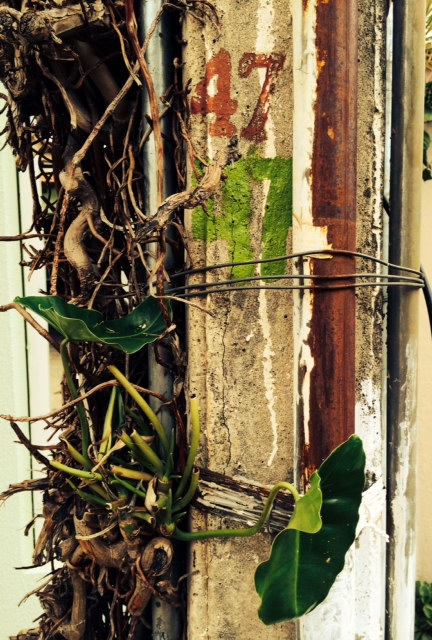
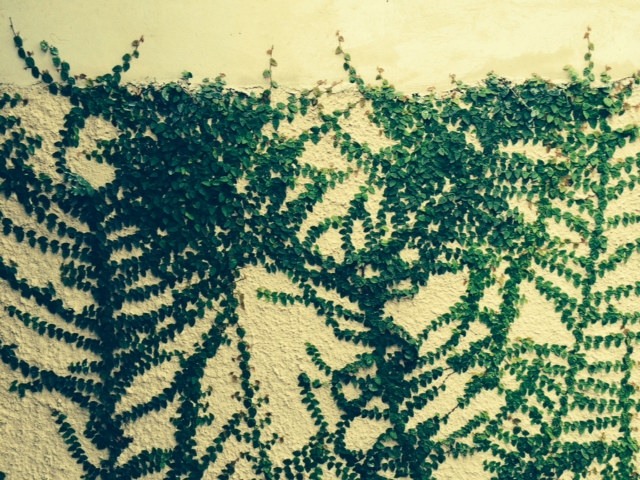
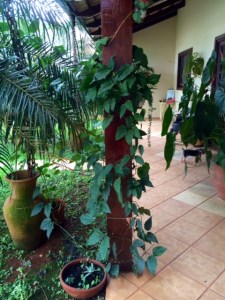
rhizoidimagery> all of the photos are of my street (1st photo) and my home (2nd and 3rd) .. you’re welcome